
According to a recent survey conducted by the non-profit organization Rest of World, the social media giant Facebook parent Meta continues to promote online gambling advertising on the platform at a time when illegal gambling is explicitly banned in multiple countries around the world. The report questions the extent to which Meta has implemented local laws and its own advertising policy.
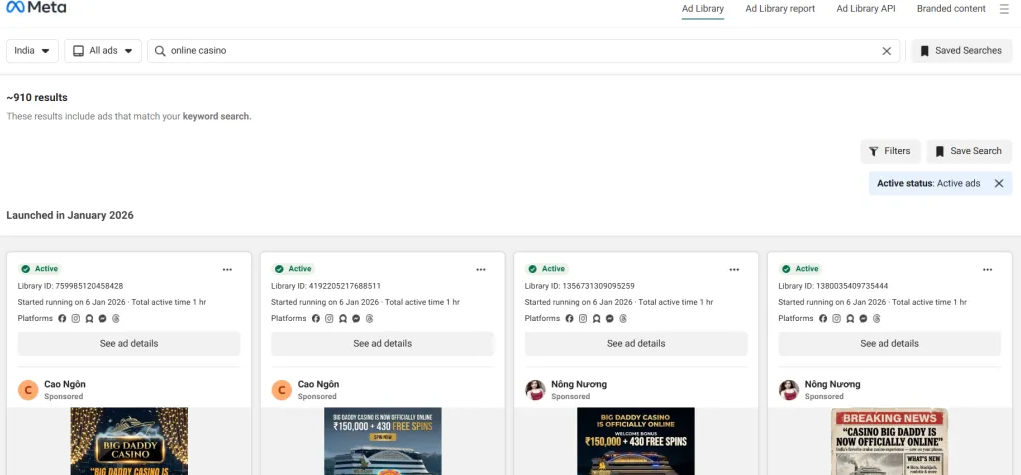
The survey found that Meta had placed illegal gambling advertising in at least 13 countries that prohibited gambling, including many parts of Asia and the Middle East, while official Meta policy classified most of those regions as “unsupported markets”.Asia’s most affected region.Between 2021 and 2024, online gambling in India surged as mobile data costs decreased and smartphones became widely available. In August 2024, the Government of India banned all online gold games and related advertisements in order to combat abuse by illegal operators and consumers. However, the investigation found that at least 140 illegal gambling advertisements were still on the Meta platform in India as of December 2024. Of even greater concern is the fact that, according to the latest data from the Meta Advertising Library, 910 advertisements were active in January 2026.
Data from the Meta Open Advertisement Bank show that thousands of active gambling advertisements still exist in Malaysia, Singapore, Pakistan and Saudi Arabia, and that 2,400 advertisements have been discontinued, but their outreach pages are still accessible, indicating chronic regulatory gaps. Malaysia was particularly prominent, with its laws explicitly prohibiting gambling advertising, but investigations found that dozens of Facebook and Instagram pages were still promoting online betting services. The analysts noted that this highlighted the deepening gap between the regulator and Meta and the difficulty for authorities to trace fast-moving and often anonymous advertising websites. In November 2025, there were over 170 gambling ads in the Philippines a month, and most of the inducing users downloaded applications that committed to “millions of cash” “recommended awards” and so-called “loss rescue” programmes. It is estimated that over 60 per cent of online gambling operations by the country ‘ s regulators are illegal. Many advertisers use virtual addresses, and advertisements disappear only for hours, making enforcement difficult. Although Thailand has recently promoted the legalization of real casinos, online casinos remain illegal. The survey found that a Thai-language page network had placed over 500 gambling advertisements on a single day, promoting real-life casinos and tiger machine games.Regulatory confrontation between Europe and BrazilThe problem is not limited to Asia. In Europe, too, Meta is facing censorship for gambling advertising: Belgian law classifies the game-opening mechanism as gambling, and investigations have found that the type of advertising placed by Meta reaches millions of users, including minors; Italy has fined Meta for violating the national gambling advertising ban; and Romanian regulatory agencies have requested it to disclose unlicensed operators ‘ related advertisements. In response, Meta plans to introduce alternative advertising in European countries this year.

In the Americas, the Office of the Attorney General of Brazil has issued a legal warning to Meta to remove illegal gambling advertising within 48 hours. An independent Reuters survey shows that Meta has earned billions of dollars from fraud and illegal advertising globally. According to analysts, Meta appears to have placed revenue above compliance with national laws, and critics warn that such advertising tactics have led to widespread illegal gambling on its platforms. As multinational regulatory pressures continue to escalate, the content review of the technology giant faces a new round of torture at the border of responsibility.