

A new report focusing on the mobile game industry in Europe, including income, contributions to employment and digital innovation, was recently released by the Candy Legend developer King.
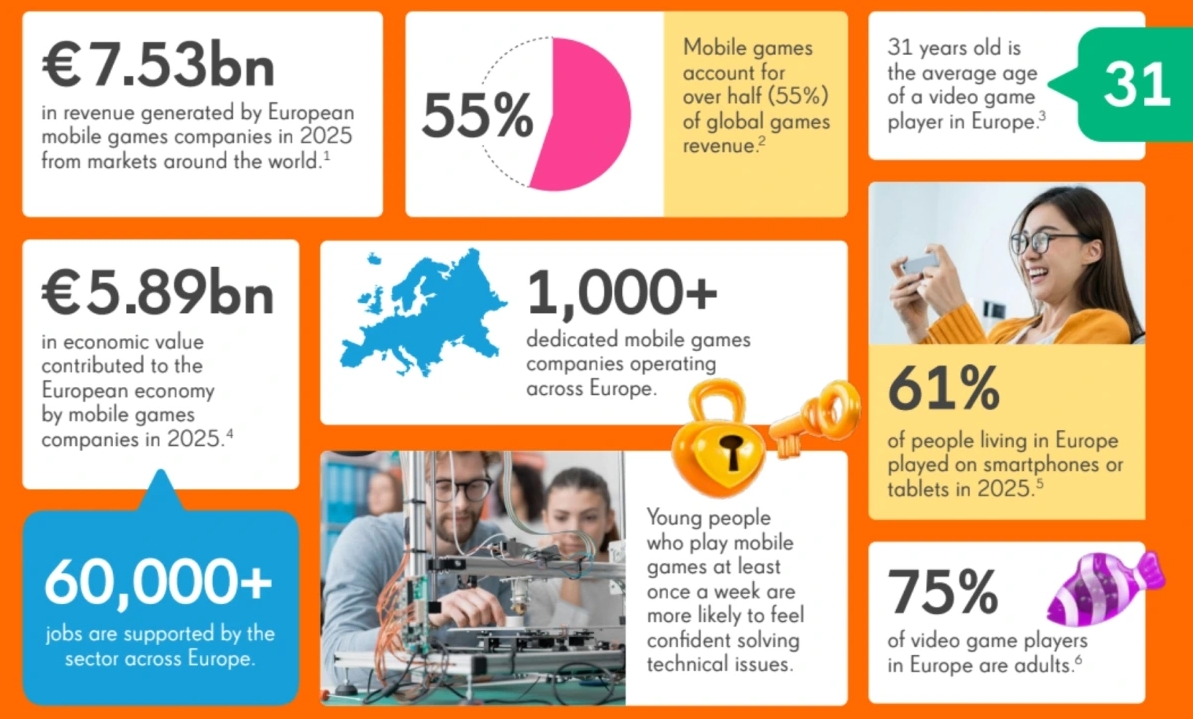
According to the European Mobile Game Impact report published by Mobile Matters, in 2025, mobile game companies in Europe earned €7.5 billion (approximately $8.7 billion) from global users, contributing about €5.9 billion (approximately $6.9 billion) in economic value to the continent. The report projects that by 2028 total income will exceed 8 billion euros (approximately $9.3 billion).
Todd Green, President of King, stated that for the European mobile game industry, it was a “critical moment” as AI and the new competition points changed the industry’s pattern. He also noted that European regulators were undertaking an extensive review of the entire digital field.
“So I think this is a good time to stop and look at mobile games, how they work and how they contribute to the economy. We ask ourselves: What is the impact and scope of the mobile game industry? There is no specific study to examine the economic and broader impact of mobile games. This seems to be an important issue to be addressed.”
Data show that last year mobile game revenues accounted for 55 per cent of total global game revenues. During the same period, 61 per cent of players in Europe played games using smartphones or tablets. Adults make up 75 per cent of players in the group and the average age of European players is 31 years.
European distributors spend 41 per cent of their annual expenditures on user acquisition and player retention, highlighting the intensity of competition. Players are clearly more inclined to move to free games, a trend more evident than other platforms, with more than 320 million free mobile players in Europe today.
The report also shows that European mobile games companies employ 30,000 people and that there are more than 1,000 such companies throughout Europe. By 2025, more than 63,000 full-time jobs will be available in mobile games studios in Europe. Revenues are concentrated in Europe’s “old centres” in Finland, Sweden, Spain, Ireland and the United Kingdom, but countries such as Cyprus, Serbia and Ukraine stand out because of their advantages if they are compared with the overall market activity of a country.
“Europe has many advantages. It brings together many creative and technocrats and has a reputation for producing high-quality games for global players. This is also home to some of the world’s leading mobile games companies, including King. We have offices in Barcelona, London, Stockholm, Malmö and Berlin, and have witnessed the quality of talent throughout the region, according to Todd Green.
One of the strengths of Europe lies in the diversification of its products: creativity, design, engineering, data, operations and new technologies. Mobile games are at the heart of this diverse combination and one of the reasons why Europe has always maintained a strong influence. The report also points out the broader culture around mobile games in Europe: entrepreneurship, unique design and a commitment to excellence.

“There are different markets. Sweden has great creative and technical power. Spain has a strong entrepreneurial ecosystem. Britain combines a mature game industry with strong digital analysis and real-time operational capabilities. Todd Green added that the future talent pool in Europe was also crucial and that young people needed opportunities to develop creative and digital skills.
“From the founding snake-eating game of Nokia’s mobile phone to the global hot game of Angry Birds, Tribal Conflict and the Candy Legend, Europe has been a catalyst for the development of the mobile game industry from the outset. Today, Europe remains one of the important centres of creativity and innovation in the mobile game industry.”
King ‘ s full report includes a breakdown of income by country, for example, Finland ‘ s income last year was Euro1.4 billion ($1.6 billion) and Spain ‘ s Euro722 million ($841 million).