
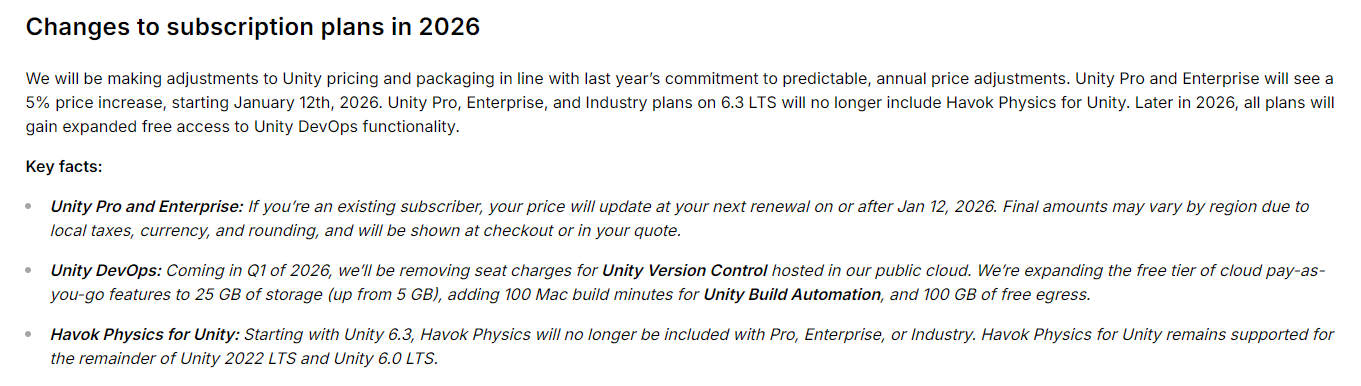
According to Mobilegamer, Unity sent e-mails to business clients this week, informing them that a new fee line for large clients would be introduced, triggering an industry shock. According to the source, should the enterprise refuse to pay the cost of this “Unity Enterprise Minimum Consumption Commitment Plan”, Unity threatened to withdraw its software authorization. Unity had previously announced a 5 per cent increase in the price of the business and professional version clients, effective 12 January 2026, but had never publicly mentioned the new plan. According to sources, Unity introduced a start-up price of $250,000 for new annual fees for business clients, up to $2 million.
The e-mail section states: “If you are required to use the Unity Enterprise under the software qualification requirements set out in the Unity Editor ‘ s Software Clause, you are required to comply with the `Unity Enterprise Minimum Consumption Commitment Scheme’. The scheme requires you to pay Unity a certain minimum consumption amount at the beginning of each subscription year, which will be used to offset the purchase of Unity subscriptions and support service products. The minimum consumption will be determined on the basis of your total receipts for the last 12 months.” One of the developers who received the mail said, “They might want to make a nice fourth quarter financial report. We can accept an increase in the authorized fee, but it is a harsh charge on a battalion scale, which is nothing but blackmail. And they’ll be able to increase their percentages in the future.” According to another source: “The developers will not buy … It’s a very `kind’ Christmas present.” The developers added: “It’s too harsh to threaten business customers with the termination of their authorization.”
This new fee model is similar to that of another game enginer, Epic, who collects about 1 per cent of the revenue share (some studios can negotiate custom protocols) for games based on fictional engine development. This was not the first time that Unity had triggered a development shock as a result of a fee policy, and in 2023 it had triggered an industry crisis with its “business-long costs” scheme. Following the inauguration of Matthew Bromberg, the new CEO of Unity, in 2024, the operating costs were formally cancelled on 12 September of the same year, returning to the traditional threshold subscription model. Matthew Bromberg, in his blog, said: “We cannot pursue profits in conflict with clients, but we must build partnerships based on trust.”